Quick Facts
- Lean Mass Ratio: In major clinical trials, up to 40% of weight lost was attributed to lean mass.
- Protein Target: Experts recommend 1.2g to 1.6g of protein per kilogram of body weight daily.
- Training Frequency: Perform resistance training 2–4 times per week to signal muscle retention.
- Metabolic Impact: Losing muscle can lead to a lower basal metabolic rate, making weight maintenance harder.
- Key Supplements: Consider creatine for muscle maintenance while on semaglutide to support cellular energy.
- Functional Focus: Prioritize relative strength and functional mobility over the absolute number on the scale.
Rapid weight loss from GLP-1 medications like Ozempic often results in the loss of both body fat and skeletal muscle. While some lean mass loss is inevitable during a significant caloric deficit, preserving muscle is critical for metabolic health and long-term vitality. To prevent muscle loss on Ozempic, experts recommend performing resistance training at least two to three times per week and significantly increasing daily protein intake to support muscle repair and skeletal muscle synthesis.
Why Ozempic Causes Muscle Loss: The Metabolic Reality
As a longevity editor, I often see patients celebrate a twenty-pound drop on the scale without realizing that five or eight of those pounds might be the very tissue that keeps them young: skeletal muscle. When you use GLP-1 receptor agonists, your appetite is suppressed, often leading to a dramatic caloric deficit. While this is the mechanism for weight loss, it places the body in a catabolic state.
When the body lacks sufficient energy from food, it doesn't just burn stored fat. It looks for the most "expensive" tissue to maintain, which is often muscle. This can lead to a condition known as Sarcopenia, or more specifically, Sarcopenic Obesity—where an individual has a high body fat percentage but dangerously low muscle mass. This shift triggers a metabolic slowdown. Because muscle is metabolically active, losing it reduces your basal metabolic rate, meaning your body burns fewer calories at rest.
The clinical data is sobering. In the 68-week STEP 1 clinical trial of semaglutide, approximately 40% of the total weight loss observed in participants was attributed to a reduction in lean body mass. For men over 50, this loss is particularly concerning as it compounds the natural age-related decline. Some experts suggest that the speed of Ozempic muscle loss can mimic 20 years of natural age-related muscle decline in just over a year of treatment.
The Protein-First Strategy: Fueling Muscle Synthesis
If you are on a GLP-1 medication, protein is no longer a "macro"—it is your medicine. To protect your body from wasting, you must meet specific protein requirements for Ozempic muscle preservation. The standard RDA is far too low for someone in a rapid weight-loss phase. I recommend aiming for 1.2 to 1.6 grams of protein per kilogram of body weight. For a 200-pound man (90kg), that means consuming roughly 110 to 145 grams of protein daily.
The focus should be on Leucine-rich proteins. Leucine is the primary amino acid that acts as a molecular "on switch" for skeletal muscle synthesis. Without enough Leucine, your body cannot effectively repair or build muscle, regardless of how much you lift.
Best High Protein Foods for Ozempic Diet
Because Ozempic slows gastric emptying, you will feel full quickly. This makes nutrient density paramount. You cannot afford to fill up on "empty" carbohydrates.
| Food Source | Protein per 100g | Key Benefit |
|---|---|---|
| Greek Yogurt (Plain) | 10g | High in Leucine and probiotics |
| Chicken Breast | 31g | Low calorie, high protein density |
| Lean Beef / Grass-fed | 26g | Rich in B12 and Iron |
| Lentils/Legumes | 9g | High fiber to help with Ozempic-related constipation |
| Whey Protein | ~25g per scoop | Easy to consume when appetite is low |
Beyond whole foods, I often suggest adding creatine for muscle maintenance while on semaglutide. Creatine monohydrate is one of the most researched supplements in the world. It helps pull water into the muscle cells and provides the phosphate groups needed for ATP production, helping you maintain strength even when calories are low.
Resistance Training: The Essential Countermeasure
You cannot diet your way to a healthy body composition. You must provide a biological reason for your body to keep its muscle. Ozempic and resistance training must go hand-in-hand. While cardio is great for heart health, it does little to prevent muscle wasting. To stimulate Hypertrophy (muscle growth), you need to challenge your muscles against resistance.
For many of my readers, especially those starting from a higher weight or dealing with joint pain, traditional heavy weightlifting can be intimidating. This is where resistance band exercises for Ozempic users become a game changer. Resistance bands provide constant tension throughout the movement and are much easier on the connective tissues.
Strategies for Different Demographics
- The Busy Professional: Focus on "compound lifts" like squats, deadlifts, and overhead presses. These use multiple muscle groups and provide the biggest hormonal bang for your buck.
- Preventing muscle loss on Ozempic for seniors: This is a matter of safety. Loss of muscle leads to reduced functional mobility and an increased risk of falls. Seniors should focus on balance-assisted squats and seated rows to maintain the strength needed for daily activities.
Lifting weights 2 to 4 times per week sends a signal to your brain that the muscle is "in use." When the body is deciding what tissue to burn for energy, it is less likely to break down the muscles you are actively challenging.
Monitoring Progress: Beyond the Scale
One of the biggest mistakes people make while on semaglutide is obsessing over the number on the scale. The scale cannot distinguish between fat, muscle, and water. A better approach is using body composition analysis.
While many clinics offer a DEXA scan, be aware that these can occasionally be misleading. As you lose weight, you also lose "intramuscular triglycerides" (fat stored inside the muscle) and water, which the scan might read as lean mass loss. However, it remains the gold standard for tracking trends over six-month intervals.
Self-Check: Signs of Muscle Wasting on Semaglutide
Watch for these red flags that indicate you are losing too much muscle too quickly:
- Grip Strength: Are jars harder to open? Do you struggle to carry grocery bags?
- Stair Fatigue: Do your legs feel heavy or shaky after a single flight of stairs?
- Postural Changes: Are you starting to slouch or feel "frail" despite the weight loss?
- The "Skinny Fat" Appearance: You are smaller in clothes, but your skin feels loose and muscle definition is non-existent.
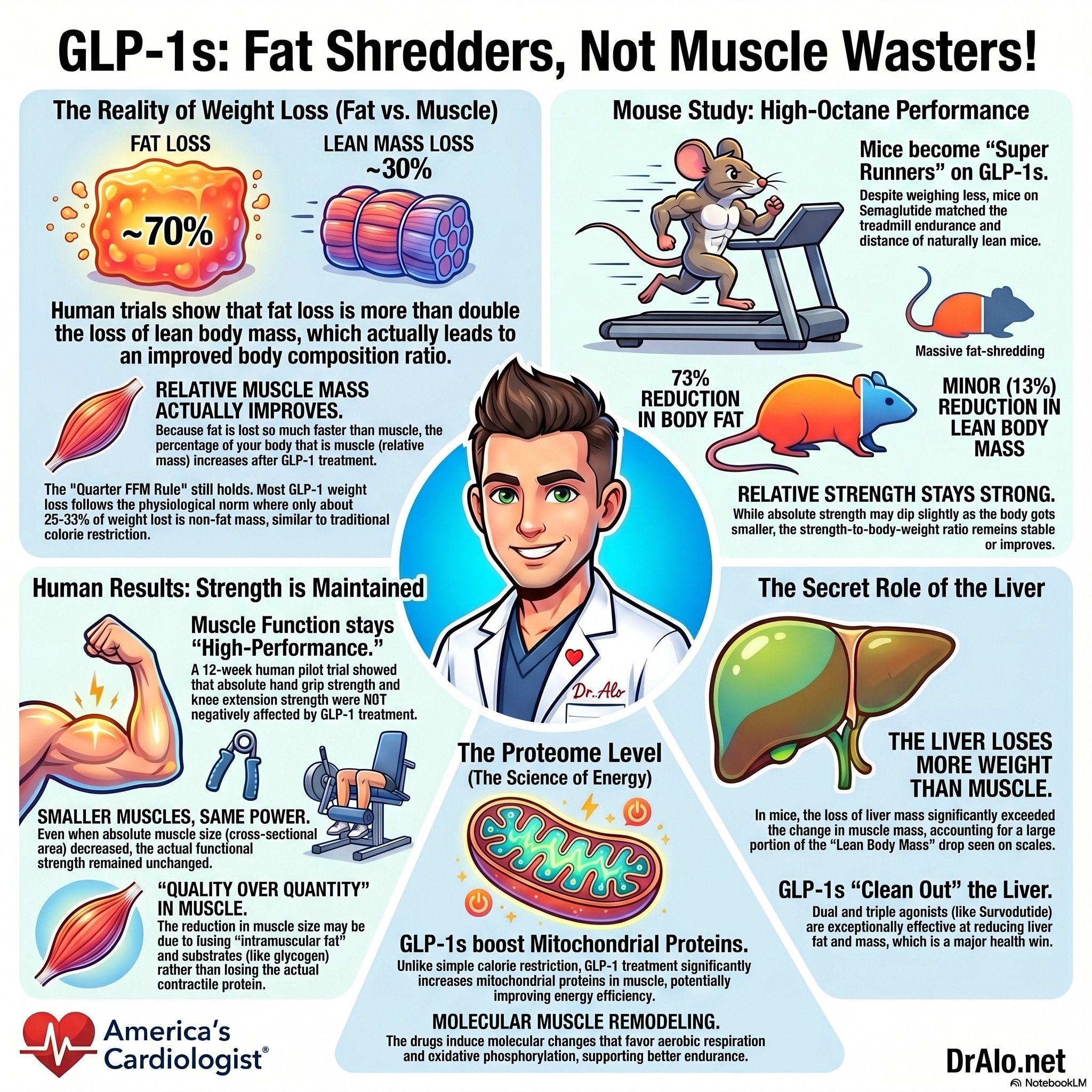
It is worth noting that while absolute lean mass usually drops, the relative health of your body often improves. Data from the STEP 1 trial showed that while absolute lean mass decreased, the proportion of lean body mass relative to total body weight actually increased by 3 percentage points after 68 weeks. The goal isn't to stay the same size—it's to ensure that fat makes up the vast majority of the weight you lose.
FAQ
Does Ozempic cause you to lose muscle?
Yes, Ozempic can lead to muscle loss. This is primarily because the medication causes a significant reduction in appetite, leading to a rapid caloric deficit. When the body loses weight quickly, it often burns both fat and skeletal muscle for energy unless proactive steps are taken to protect the lean tissue.
How do I prevent muscle loss while taking Ozempic?
To prevent muscle loss on Ozempic, you should focus on two pillars: high protein intake and consistent resistance training. Aim for 1.2 to 1.6 grams of protein per kilogram of body weight and engage in strength-building exercises at least two to three times per week to signal the body to preserve lean mass.
Is muscle loss a common side effect of semaglutide?
Muscle loss is a frequent side effect observed in clinical trials for GLP-1 medications like semaglutide. Research indicates that a substantial portion of the weight lost by participants—often between 20% and 40%—comes from lean body mass rather than adipose tissue.
How much of the weight lost on Ozempic is muscle?
In the STEP 1 clinical trial, participants lost approximately 40% of their total weight from lean mass. However, with proper intervention, such as a high-protein diet and weight lifting, this percentage can be significantly reduced to ensure the weight loss is primarily from body fat.
Can strength training stop muscle loss while on weight loss injections?
While it may not stop muscle loss entirely during a severe caloric deficit, strength training is the most effective way to minimize it. Resistance training stimulates muscle protein synthesis and provides the mechanical load necessary to tell the body to prioritize fat burning over muscle breakdown.
Is the muscle loss from Ozempic reversible?
Yes, the muscle loss is reversible through a dedicated hypertrophy-focused exercise program and a surplus of high-quality protein once the weight loss phase has stabilized. However, it is much easier to preserve lean muscle on Ozempic during the weight loss process than it is to rebuild it after significant wasting has occurred.