Quick Facts
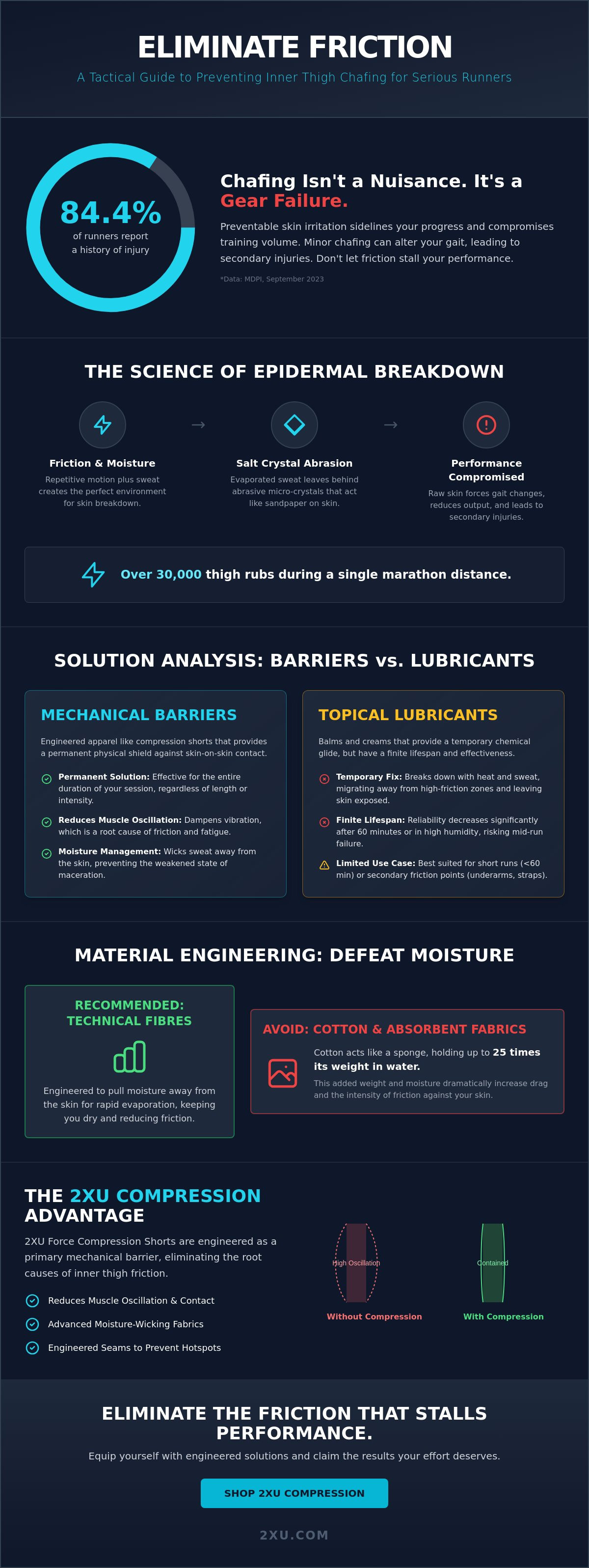
- The Reality: Research shows that 92% of marathon runners experience chafing mid-race, with over two-thirds of those cases resulting in skin bleeding.
- The Cause: Chafing is the result of repetitive skin-on-skin friction or fabric-on-skin contact, exacerbated by salt crystal residue from evaporated sweat.
- Primary Solution: Switch to technical performance fabrics and utilize a silicone-based barrier on high-friction zones to maintain epidermis integrity.
- The Humidity Rule: In environments where humidity exceeds 60%, sweat cannot evaporate, leading to skin maceration and a significantly higher risk of mechanical tearing.
- Zonal Defense: Focus prevention on the "Big Three": inner thighs, underarms, and the chest area to ensure pain-free marathon training.
- Treatment: If the skin barrier is breached, use zinc oxide ointment to accelerate skin barrier repair and prevent infection.
To prevent running chafing while training or racing, you must wear tight-fitting compression shorts or leggings made of technical performance fabrics to eliminate skin-on-skin friction and reduce moisture buildup. Additionally, applying specialized anti-chafing lubricants for runners to high-friction areas creates a protective silicone-based barrier that minimizes mechanical irritation even during long-distance efforts.

The Science of Friction: Salt and Maceration
As a coach, I see runners focus intensely on their VO2 max and split times while completely ignoring the health of their largest organ: the skin. Chafing isn't just a minor annoyance; it is a dermatological breakdown that can end a race. To understand how to prevent running chafing, you have to understand what is happening at the microscopic level.
When you run, your body cools itself through perspiration. As the liquid component of sweat evaporates, it leaves behind salt crystal residue. These microscopic crystals are essentially sandpaper. Every stride you take during marathon training rubs these crystals against your skin. If you are wearing the wrong gear, this friction is amplified.
Furthermore, a study on sports-related dermatoses found that 42.1% of road runners experience chafing, making it the second most common skin-related issue after blisters. This often occurs due to skin maceration. Maceration happens when skin remains wet for too long, causing the epidermis to soften and break down. Once the skin is macerated, it loses its structural integrity, making it incredibly easy for mechanical tearing to occur. This is why managing moisture is just as important as managing friction.
The 'Hot Spot' Early Warning System If you feel a slight stinging or warmth in a specific area during your run, do not ignore it. This is a "hot spot." It indicates that the epidermis integrity is being challenged but hasn't yet failed. If possible, stop and apply more lubricant or adjust your gear immediately to prevent a full-blown wound.
Pro Tip 1 & 2: Mechanical Barriers and the Gear Guide
The first step in any results-driven training program is selecting the right tools. When it comes to your wardrobe, the debate over moisture wicking running gear vs cotton for chafing has a clear winner. Cotton is a runner’s worst enemy. It is a hydrophilic fiber, meaning it loves water. Cotton can absorb up to 25 times its weight in moisture, holding that dampness directly against your skin. This creates the perfect environment for skin maceration.
Instead, you need to invest in moisture-wicking running gear made from synthetic blends like polyester, nylon, or Lycra. These technical performance fabrics are hydrophobic; they pull sweat away from the skin and move it to the outer surface of the fabric where it can evaporate quickly.
Beyond the fabric type, the fit of the garment is crucial. This is where we discuss the benefits of compression shorts for running chafing. Loose-fitting shorts allow for skin-on-skin friction between the thighs. Compression gear provides a physical barrier that stays put. By hugging the musculature, compression shorts reduce muscle oscillation and, more importantly, ensure that fabric-on-fabric contact replaces skin-on-skin contact.
| Feature | Cotton Apparel | Technical Performance Fabrics |
|---|---|---|
| Moisture Management | Absorbs and retains sweat | Wicks moisture away from skin |
| Weight when wet | Heavy and sagging | Remains lightweight |
| Friction Level | High (leads to tearing) | Low (smooth surface) |
| Seam Construction | Often bulky and abrasive | Usually flatlock seams |
| Best For | Post-run lounging | High-intensity marathon training |
When shopping for gear, look specifically for flatlock seams. Unlike traditional seams that have a raised edge, flatlock seams are stitched flat against the material, eliminating the "sawing" effect that occurs over thousands of repetitions during a long run.

Pro Tip 3 & 4: Chemical Barriers and Topical Solutions
Even with the best gear, some areas of the body will still experience friction. This is where chemical barriers come into play. Many beginners reach for petroleum jelly, but for serious athletes, it’s not always the best choice. While it provides a temporary slide, petroleum-based products tend to migrate, liquefy with body heat, and can stain your expensive technical performance fabrics.
For the best anti chafing lubricants for long distance runners, I recommend a silicone-based barrier. Silicone is much more durable than petroleum. It stays on the surface of the skin longer, resists being washed away by heavy sweat, and provides a superior "slip" that lasts for hours. These specialized balms often come in easy-to-apply sticks that allow you to coat high-risk zones without getting your hands greasy.
Environmental conditions play a massive role here as well. Preventing running chafing in high humidity requires a different strategy. In high-humidity environments, sweat cannot evaporate efficiently. Your skin stays perpetually wet, increasing the risk of maceration. In these conditions, you need to be more aggressive with your application of anti-chafing lubricants for runners. I tell my athletes to "double-bag" their protection: apply a thick layer of balm and then wear your compression gear over it. This creates a fail-safe system that protects the skin even when the air is thick with moisture.
Pro Tip 5 & 6: Zonal Defense for Thighs, Nipples, and Underarms
Different parts of your body require different defensive strategies. We call this Zonal Defense.
First, let’s talk about the thighs. This is the most common area for irritation. To understand how to prevent inner thigh chafing for runners, you must eliminate the skin-on-skin friction that occurs with every stride. If you prefer running in loose shorts, ensure they have a built-in compression liner. If you run in tights, make sure they are high-waisted enough to prevent sagging, which can create new friction points in the groin area.
Second, we must address a painful reality for many: nipple chafing. Research indicates that approximately 36% of runners who log more than 40 miles per week suffer from painful nipple chafing. This is caused by the constant friction of a damp shirt against sensitive tissue. The solution is simple but non-negotiable for long runs. You can use adhesive nipple guards or specialized medical tape. If you prefer a non-adhesive route, apply a very heavy, high-viscosity silicone balm specifically to the chest area.
Finally, don't overlook your underarms and the areas where gear contacts your body. If you wear a hydration vest, the straps can cause significant irritation over time. Apply your lubricant to the neck, collarbones, and ribs—anywhere the vest might rub. This is an essential part of your inner thigh chafing prevention and overall skin protection strategy.
Pro Tip 7: Post-Run Hygiene and Recovery
What you do after the run is just as important as what you do before. If you have successfully avoided chafing, your first priority is to get out of your damp clothes immediately. Salt crystal residue will continue to irritate your skin even after you stop moving. Rinse off with lukewarm water and a soap-free cleanser. Avoid scalding hot showers, which can strip away the natural oils that protect your skin barrier.
If you do end up with a "burn," your focus shifts to treatment and recovery. This is not the time for standard lotions. To know how to treat running chafing after a workout, you need to look for products containing zinc oxide ointment. Zinc oxide provides a breathable, protective barrier that keeps bacteria out while allowing the skin to heal. It is also an anti-inflammatory that helps soothe the stinging sensation.
Apply a generous layer of a skin barrier repair cream before bed. Look for ingredients like ceramides or panthenol, which help rebuild the epidermis. Avoid any products with alcohol or heavy fragrances, as these will only exacerbate the pain and delay healing. If you follow these recovery steps, you can usually get back to your marathon training within 24 to 48 hours.
FAQ
How do you stop chafing while running?
To stop chafing, you need to address both the mechanical and chemical causes of friction. This involves wearing moisture-wicking running gear that fits tightly to the skin, such as compression shorts, and applying a long-lasting silicone-based lubricant to areas where skin rubs against skin or fabric.
Does Vaseline help prevent running chafing?
Vaseline can provide temporary relief, but it is not the ideal solution for long-distance runners. It tends to melt with body heat and can stain technical fabrics. Specialized anti-chafing lubricants for runners are formulated to stay on the skin longer and provide better protection against sweat and humidity.
What type of clothing is best for avoiding chafing?
The best clothing for preventing chafing is made from technical performance fabrics like polyester or nylon blends. These materials wick sweat away from the skin. Look for items with flatlock seams and a snug fit, such as compression gear, to minimize the movement of fabric against your skin.
How do you treat running chafing after it happens?
Treatment starts with cleaning the area with lukewarm water and a mild, soap-free cleanser. Once dry, apply zinc oxide ointment or a dedicated skin barrier repair cream to soothe the inflammation and protect the area from further irritation while it heals.
How do runners prevent nipple chafing?
Runners can prevent nipple chafing by using adhesive nipple covers, medical tape, or a very thick application of anti-chafe balm. Ensuring your shirt is made of high-quality moisture-wicking gear also reduces the weight and abrasiveness of the fabric when it becomes wet with sweat.